
This study investigated the influence of environmental factors on the distribution of Afruca tangeri across three mangrove belts in the Saloum Delta National Park through annual population monitoring based on burrow counts, combined with the analysis of physicochemical parameters of interstitial water collected from the burrows. Sampling was conducted from August 2023 to July 2024 during low tide at the Bakadadji, Missirah, and Bettenty sites. The results showed that interstitial water temperature and pH were relatively homogeneous among mangrove belts and study sites, with average values of approximately 30°C and pH ranging from 6 to 7. In contrast, electrical conductivity (EC, mS/cm), salinity (psu), and dissolved oxygen (DO, mg/L) exhibited marked spatial variations across mangrove belts and sites. Statistical analyses using the Kruskal–Wallis test indicated that most physicochemical parameters did not differ significantly (p > 0.05), except for salinity, which showed highly significant variation (p < 0.05). The mean population density of A. tangeri was estimated at 63.02 individuals/m2 across the study area. Density varied significantly among mangrove belts, reaching the highest values under Rhizophora (100 ind/m2), intermediate values under Avicennia (71.7 ind/m2), and the lowest values in unvegetated areas (49.1 ind/m2). At the site level, the highest densities were recorded at Bakadadji (68.67 ind/m2) and Missirah (67.60 ind/m2), compared with Bettenty, although these differences were not statistically significant (p > 0.05). Principal Component Analysis (PCA) biplot revealed that variations in A. tangeri density were closely associated with the physicochemical characteristics of the habitat, particularly salinity and dissolved oxygen. Salinity emerged as the main factor controlling the spatial distribution of A. tangeri with in the Saloum Delta National Park.
| Published in | American Journal of Life Sciences (Volume 14, Issue 6) |
| DOI | 10.11648/j.ajls.20261406.12 |
| Page(s) | 154-166 |
| Creative Commons |
This is an Open Access article, distributed under the terms of the Creative Commons Attribution 4.0 International License (http://creativecommons.org/licenses/by/4.0/), which permits unrestricted use, distribution and reproduction in any medium or format, provided the original work is properly cited. |
| Copyright |
Copyright © The Author(s), 2026. Published by Science Publishing Group |
Afruca Tangeri, Bioturbation, Burrow, Physicochemical Factors, Saloum Delta, Senegal
PC | Ceinture | K2 | df | p-value | Signif | Method |
|---|---|---|---|---|---|---|
T | Av – Nue - Rh | 1,1556 | 2 | 0,5611 | ns | Kruskal-Wallis |
pH | Av – Nue - Rh | 1,4118 | 2 | 0,4937 | ns | Kruskal-Wallis |
CE | Av – Nue - Rh | 1,8667 | 2 | 0,3932 | ns | Kruskal-Wallis |
Sal | Av – Nue - Rh | 0,26667 | 2 | 0,26667 | ns | Kruskal-Wallis |
O2 dissous | Av – Nue - Rh | 0,08889 | 2 | 0,9565 | ns | Kruskal-Wallis |
PC | Site | K2 | df | p-value | Signif | Method |
|---|---|---|---|---|---|---|
T | Bd – Bt - M | 5,4222 | 2 | 0,06646 | ns | Kruskal-Wallis |
pH | Bd – Bt - M | 3,3165 | 2 | 0,1905 | ns | Kruskal-Wallis |
CE | Bd – Bt - M | 2,4 | 2 | 0,3012 | ns | Kruskal-Wallis |
Sal | Bd – Bt - M | 6,4889 | 2 | 0,0399 | * | Kruskal-Wallis |
O2 dissous | Bd – Bt - M | 4,2667 | 2 | 0,1184 | ns | Kruskal-Wallis |
Ceinture | Avicenia | Nue |
|---|---|---|
Nue | 0.01518 | - |
Rhizophoras | 0.11980 | 0.00045 |
PNDS | Saloum Delta National Park |
Bd | Bakadadji |
M | Missirah |
Bt | Bettenty |
| [1] | A. O. Lawal-Are & H. Nwankwo, « Biology of the Hairy Mangrove Crab, Sersema huzardii (Decapoda: Graspidae) from a Tropical Estuarine Lagoon », Journal of American Science, vol. 7, no 7, p. 402‑408, 2011. |
| [2] | P. S. Diouf, "The Fish Populations of the Estuarine Environments of West Africa: The Example of the Hyperhaline Si-né-Saloum Estuary," Thesis and Microfiche Documents, Office of Scientific and Technical Research Overseas (ORSTOM), Paris, 1996. |
| [3] | I. K. Esenowo & A. A. A. Ugwumba, « Composition and Abundance of Macrobenthos in Majidun River, Ikorordu Lagos State, Nigeria », Research J. of Biological Sciences, vol. 5, no 8, p. 556‑560, 2010, |
| [4] | J. M. Teal, « Respiration of Crabs in Georgia Salt Marshes and Its Relation to Their Ecology », Physiological Zoology, vol. 32, no 1, p. 1‑14, 1959, |
| [5] | E. Fanjul, M. C. Bazterrica, M. Escapa, M. A. Grela, & O. Iribarne, « Impact of crab bioturbation on benthic flux and nitrogen dynamics of Southwest Atlantic intertidal marshes and mudflats », Estuarine, Coastal and Shelf Science, vol. 92, no 4, p. 629‑638, 2011, |
| [6] | G. Holguin, P. Vazquez, & Y. Bashan, « The role of sediment microorganisms in the productivity, conservation, and rehabilitation of mangrove ecosystems: an overview », Biol Fertil Soils, vol. 33, no 4, p. 265‑278, 2001, |
| [7] | E. Kristensen, S. Bouillon, T. Dittmar, & C. Marchand, « Organic carbon dynamics in mangrove ecosystems: A review », Aquatic Botany, vol. 89, no 2, p. 201‑219, 2008, |
| [8] | D. M. Alongi, « Mangrove forests: Resilience, protection from tsunamis, and responses to global climate change », Estuarine, Coastal and Shelf Science, vol. 76, no 1, p. 1‑13, 2008, |
| [9] | F. Bartolini, F. Cimò, M. Fusi, F. Dahdouh-Guebas, G. P. Lopes, & S. Cannicci, « The effect of sewage discharge on the ecosystem engineering activities of two East African fiddler crab species: Consequences for mangrove ecosystem functioning », Marine Environmental Research, vol. 71, no 1, p. 53‑61, 2011, |
| [10] | S. Cannicci, D. Burrows, S. Fratini, T. J. Smith, J. Offenberg, & F. Dahdouh-Guebas, « Faunal impact on vegetation structure and ecosystem function in mangrove forests: A review », Aquatic Botany, vol. 89, no 2, p. 186‑200, 2008, |
| [11] | E. Kristensen, « Mangrove crabs as ecosystem engineers; with emphasis on sediment processes », Journal of Sea Research, vol. 59, no 1‑2, p. 30‑43, 2008, |
| [12] | E. Kristensen, G. Penha-Lopes, M. Delefosse, T. Valdemarsen, C. Quintana, & G. Banta, « What is bioturbation? The need for a precise definition for fauna in aquatic sciences », Mar. Ecol. Prog. Ser., vol. 446, p. 285‑302, 2012, |
| [13] | E. Kristensen & D. M. Alongi, « Control by fiddler crabs (Uca vocans) and plant roots (Avicennia marina) on carbon, iron, and sulfur biogeochemistry in mangrove sediment », Limnology and Oceanography, vol. 51, no 4, p. 1557‑1571, 2006, |
| [14] | S. Y. Lee, « Ecological role of grapsid crabs in mangrove ecosystems: a review », Mar. Freshwater Res., vol. 49, no 4, p. 335, 1998, |
| [15] | T. Xie et al., « Potential Effect of Bioturbation by Burrowing Crabs on Sediment Parameters in Coastal Salt Marshes », Wetlands, vol. 40, no 6, p. 2775‑2784,. 2020, |
| [16] | D. M. Alongi, « Present state and future of the world’s mangrove forests », Environmental Conservation, vol. 29, no 3, p. 331‑349, 2002, |
| [17] | D. M. Alongi, Ed., « The Forest Floor », in The Energetics of Mangrove Forests, Dordrecht: Springer Netherlands, 2009, p. 89‑127. |
| [18] | A. C. Ferreira, L. E. A. Bezerra, & H. Matthews-Cascon, « Aboveground carbon stock in a restored neotropical mangrove: influence of management and brachyuran crab assemblage », Wetlands Ecol Manage, vol. 27, no 2, p. 223‑242, juin 2019, |
| [19] | J. Q. Wang et al., « Bioturbation of Burrowing Crabs Promotes Sediment Turnover and Carbon and Nitrogen Movements in an Estuarine Salt Marsh », Ecosystems, vol. 13, no 4, p. 586‑599, 2010, |
| [20] | S. S. L. Lim & C. H. Diong, « Burrow-Morphological Characters of the Fiddler Crab, Uca annulipes (H. Milne Edwards, 1837) and Ecological Correlates in a Lagoonal Beach on Pulau Hantu, Singapore », Crustaceana, vol. 76, no 9, p. 1055‑1069, 2003. |
| [21] | I. Nagelkerken et al., « The habitat function of mangroves for terrestrial and marine fauna: A review », Aquatic Botany, vol. 89, no 2, p. 155‑185, 2008, |
| [22] | Y. Yang, Q. Liang, Y. Peng, & D. M. Paterson, « Differential mediation of biogeochemical processes through bioturbation by fiddler and sesarmid mangrove crabs », Marine Pollution Bulletin, vol. 211, p. 117431, 2025, |
| [23] | A. B. Diop et al., «Characterization of the Saloum Mangrove, Senegal », ResearchGate, vol. 8, no 2, p. 57‑66, 2023. |
| [24] | PAG PNDS, « Plan d’Amenagement et de Gestion du Parc National du Delta du Saloum (PNDS) 2021-2025 », Centre de Suivi Ecologique, 2021. |
| [25] | D. R. Colby & M. S. Fonseca, « Population dynamics, spatial dispersion and somatic growth of the sand fiddler crab Uca pugilator », Marine Ecology Progress Series, vol. 16, no 3, p. 269‑279, 1984. |
| [26] | B. Wolfrath, « Field experiments on feeding of European fiddler crab Uca tangeri », Marine Ecology Progress Series, vol. 90, no 1, p. 39‑43, 1992. |
| [27] | J. M. Jordão & R. F. Oliveira, « Comparison of non-invasive methods for quantifying population density of the fiddler crab Uca tangeri », J. Mar. Biol. Ass., vol. 83, no 5, p. 981‑982, oct. 2003, |
| [28] | A. Macia, I. Quincardete, & J. Paula, « A comparison of alternative methods for estimating population density of the fiddler crab Uca annulipes at Saco Mangrove, Inhaca Island (Mozambique) », in Advances in Decapod Crustacean Research, J. P. M. Paula, A. A. V. Flores, et C. H. J. M. Fransen, Ed., Dordrecht: Springer Netherlands, 2001, p. 213‑219. |
| [29] | E. C. Mouton & D. L. Felder, « Burrow distributions and population estimates for the fiddler crabsUca spinicarpa andUca longisignalis in a Gulf of Mexico salt marsh », Estuaries, vol. 19, no 1, p. 51‑61, mars 1996, |
| [30] | M. Skov, M. Vannini, J. Shunula, R. Hartnoll, & S. Cannicci, « Quantifying the density of mangrove crabs: Ocypodidae and Grapsidae », Marine Biology, vol. 141, no 4, p. 725‑732, oct. 2002, |
| [31] | M. A. A. Pinheiro, L. F. A. Duarte, T. R. Toledo, M. L. Adam,& R. A. Torres, « Habitat monitoring and genotoxicity in Ucides cordatus (Crustacea: Ucididae), as tools to manage a mangrove reserve in southeastern Brazil », Environ Monit Assess, vol. 185, no 10, p. 8273‑8285, oct. 2013, |
| [32] | A. C. Wunderlich, M. A. A. Pinheiro, & A. M. T. Rodrigues, « Biologia do caranguejo-uça, Ucides cordatus (Crustacea: Decapoda: Brachyura), na Baía da Babitonga, Santa Catarina, Brasil », Rev. Bras. Zool., vol. 25, p. 188‑198, 2008, |
| [33] | M. W. Skov et R. G. Hartnoll, « Comparative suitability of binocular observation, burrow counting and excavation for the quantification of the mangrove fiddler crab Uca annulipes (H. Milne Edwards) », in Advances in Decapod Crustacean Research, J. P. M. Paula, A. A. V. Flores, & C. H. J. M. Fransen, Ed., Dordrecht: Springer Netherlands, 2001, p. 201‑212. |
| [34] | E. S. Diop, I. Ndour, & M. C. Cormier-Salem, Estuaires Et Mangroves d’Afrique De l’Ouest. IRD Editions, 2014. |
| [35] | I. Sakho, V. Mesnage, J. Deloffre, R. Lafite, I. Niang, & G. Faye, « The influence of natural and anthropogenic factors on mangrove dynamics over 60 years: The Somone Estuary, Senegal », Estuarine, Coastal and Shelf Science, vol. 94, no 1, p. 93‑101, 2011, |
| [36] | N. M. Dieng, «Study of the relationship between surface water and groundwater in the context of climate change in the southern zone of the lower Saloum basin (Senegal), Doctoral Thesis, Cheikh Anta Diop University of Dakar (UCAD), Senegal, 2017. |
| [37] | C. Marchand, F. Baltzer, E. Lallier-Verges, & P. Alberic, « Pore-water chemistry in mangrove sediments: relationship with species composition and developmental stages (French Guiana) », Marine Geology, vol. 208, no 2, p. 361‑381, 2004, |
| [38] | A. Guisse, M. N. Faye, & N. Diallo, «Influence of pH, water salinity, and soil texture on the vegetation of the mangrove in the Saloum estuary in Senegal », Journal of Sciences and Technologies, vol. 5, no 1, p. 8‑17, 2007. |
| [39] | S. Diop, "The West African Coast: from Saloum (Senegal) to Mellacorée (Republic of Guinea)," State Doctorate Thesis, Louis Pasteur University, Strasbourg, France, 1990. |
| [40] |
B. Faye, « Dynamics and detection of land use changes in the northern part of the Saloum estuary from 1973 to 2014 », Revue Marocaine de Géomorphologie, no 2, 2018,
https://revues.imist.ma/index.php/Remageom/article/view/10566 |
| [41] | E. J. Anthony, R. Almar, T. Aagaard, & S. G. Jensen, « Recent shoreline changes and coastal dynamics along the West African coast », Journal of Coastal Research, vol. 35, no 5, p. 1050‑1063, 2019. |
| [42] | L. Morrow & N. H. Nickerson, « Concentrations de sel dans les eaux souterraines sous Rhizophora mangle et Avicennia germinans », Rhodora, vol. 75, no 801, p. 102‑106, 1973. |
| [43] | E. Kristensen, « Organic matter diagenesis at the oxic/anoxic interface in coastal marine sediments, with emphasis on the role of burrowing animals », in Life at Interfaces and Under Extreme Conditions, G. Liebezeit, S. Dittmann, et I. Kröncke, Ed., Dordrecht: Springer Netherlands, 2000, p. 1‑24. |
| [44] | F. Botto, I. Valiela, O. Iribarne, P. Martinetto, & J. Alberti, « Impact of burrowing crabs on C and N sources, control, and transformations in sediments andfood webs of SW Atlantic estuaries », Marine Ecology Progress Series, vol. 293, p. 155‑164, juin 2005, |
| [45] | J. M. Ecoutin & P. S. Diouf, « The Saloum estuary (Senegal): a hypersaline ecosystem. In : C. H. R. Heip, P. M. J. Herman & J. J. Middelburg (Eds.), The West African Marine Ecoregion », Ocean & Coastal Management, vol. 46, no 1‑2, p. 183‑200, 2003. |
| [46] | S. Sarker, M. Masud-Ul-Alam, M. S. Hossain, S. Rahman Chowdhury, & S. Sharifuzzaman, « A review of bioturbation and sediment organic geochemistry in mangroves », Geological Journal, vol. 56, no 5, p. 2439‑2450, 2021, |
| [47] | L. S. Manga, A. Faye, J. Fall, et M. Diouf, « Size class, density, and distribution of Uca tangeri (Eydoux, 1835; Decapoda: Ocypodidae) in the mangrove ecosystems of Senegal », Int. J. Fish. Aquat. Stud., vol. 11, no 1, p. 133‑140, janv. 2023, |
| [48] | P. S. Diouf, T. Bousso, H. D. Diadhiou, & M. Kebe, "The Fisheries in the Estuaries of Senegal," in Coastal and Marine Resource Management in Senegal, Proceedings of the Gorée Workshop, Senegal, 1992, p. 27‑29. |
| [49] | N. A. Qureshi et N. U. Saher, « Burrow morphology of three species of fiddler crab (Uca) along the coast of Pakistan », Belg. J. Zool., vol. 142, no 2, p. 114‑126, 2012, |
| [50] | P. Rianta, W. Ernawati, G. Chen, & S. Chen, « Diversity and abundance of mangrove fiddle crabs, genus Uca (Decapoda, Ocypodidae) at a mangrove in Kema, North Sulawesi, Indonesia », Acta Oceanol. Sin., vol. 37, no 12, p. 92‑96, 2018, |
| [51] | T. A. Mota, M. A. A. Pinheiro, N. S. Evangelista-Barreto, & S. S. Da Rocha, « Density and extractive potential of “uça”-crab, Ucides cordatus (Linnaeus, 1763), in mangroves of the “Todos os Santos” Bay, Bahia, Brazil », Fisheries Research, vol. 265, p. 106733, sept. 2023, |
| [52] | M. A. A. Pinheiro et al., « Advances in population monitoring of the mangrove ‘uça’-crab (Ucides cordatus): reduction of body size variance for better evaluation of population structure and extractive potential », Marine Biology Research, vol. 19, no 2‑3, p. 141‑153, 2023, |
| [53] | J. Crane, Fiddler Crabs of the World OCYPODDAE: GENUS UCA. Princeton University Press, 1975. |
| [54] | R. A. Christofoletti, G. Y. Hattori, & M. A. A. Pinheiro, « Food selection by a mangrove crab: temporal changes in fasted animals », Hydrobiologia, vol. 702, no 1, p. 63‑72, 2013, |
| [55] | I. Nordhaus, K. Diele, & M. Wolff, « Activity patterns, feeding and burrowing behaviour of the crab Ucides cordatus (Ucididae) in a high intertidal mangrove forest in North Brazil », Journal of Experimental Marine Biology and Ecology, vol. 374, no 2, p. 104‑112, juin 2009, |
| [56] | I. Nordhaus & M. Wolff, « Feeding ecology of the mangrove crab Ucides cordatus (Ocypodidae): food choice, food quality and assimilation efficiency », Mar Biol, vol. 151, no 5, p. 1665‑1681, 2007, |
| [57] | M. A. A. Pinheiro, M. R. Souza, L. C. M. Santos, & R. F. C. Fontes, « Density, abundance and extractive potential of the mangrove crab, Ucides cordatus (Linnaeus, 1763) (Brachyura, Ocypodidae): subsidies for fishery management », An. Acad. Bras. Ciênc., vol. 90, no 2, p. 1381‑1395, 2018, |
| [58] | A. C. Wunderlich & M. A. A. Pinheiro, « Partitioning of mangrove habitat by Ucides cordatus (Ucididae): effects of tidal flooding degree and tree species composition throughout its life cycle », Helgoland Marine Research, vol. 64, p. 279‑289, 2013. |
| [59] | R. D. C. Conti et R. C. Nalesso, « Status of the population structure of the mangrove crab Ucides cordatus (Decapoda: Ocypodidae) on the Piraquê-açu River estuary, Espírito Santo, Brazil », Braz. j. oceanogr., vol. 58, no 2, p. 81‑92, 2010, |
| [60] | P. Goes, J. O. Branco, M. A. A. Pinheiro, E. Barbieri, D. Costa, & L. L. Fernandes, « Bioecology of the uça-crab, Ucides cordatus (Linnaeus, 1763), in Vitória Bay, Espírito Santo State, Brazil », Braz. j. oceanogr., vol. 58, no 2, p. 153‑163, 2010, |
| [61] | C. Edmond, J. Mouton,& D. L. Felder, « Reproduction of the Fiddler Crabs Uca longisignalis and Uca spinicarpa in a Gulf of Mexico Salt Marsh », Estuaries, vol. 18, no 3, p. 469‑481, 1995, |
| [62] | V. M. Ngo-Massou, G. L. Essome-Koum, E. Kotte-Mapoko, & N. Din, « Biology and Distribution of Mangrove Crabs in the Wouri River Estuary, Douala, Cameroon », JWARP, vol. 06, no 04, p. 236‑248, 2014, |
| [63] | M. Mokhtari, A. Savari, H. Rezai, P. Kochanian, & A. Bitaab, « Population ecology of fiddler crab, Uca lactea annulipes (Decapoda: Ocypodidae) in Sirik mangrove estuary, Iran », Estuarine, Coastal and Shelf Science, vol. 76, no 2, p. 273‑281, janv. 2008, |
| [64] | M. W. Skov & R. G. Hartnoll, « Paradoxical selective feeding on a low-nutrient diet: why do mangrove crabs eat leaves? », Oecologia, vol. 131, no 1, p. 1‑7, mars 2002, |
| [65] | K. Kathiresan & B. L. Bingham, « Biology of mangroves and mangrove Ecosystems », Progress in marine biology, vol. 40, p. 81‑251, 2001, |
| [66] | S. Cannicci, M. Gomei, F. Dahdouh-Guebas, R. Rorandelli, & A. Terlizzi, « Influence of seasonal food abundance and quality on the feeding habits of an opportunistic feeder, the intertidal crab Pachygrapsus marmoratus », Mar Biol, vol. 151, no 4, p. 1331‑1342, 2007, |
| [67] | L. Ibanga, J. A. Nkwoji, A. Usese, I. Onyema, & O. Chukwu, « Macrobenthic invertebrate community structure and heavy metals concentrations in the crab, Uca tangeri in a Tidal Creek, Niger delta, Nigeria ». |
| [68] | R. O. Moruf & T. A. Ojetayo, « Biology of the West African fiddler crab, Uca tangeri (Eydoux, 1835) (Decapoda: Ocypodidae) from a mangrove wetland in Lagos, Nigeria », International Journal of Aquatic Biology, vol. 5, no 4, p. 263‑267, 2017, |
| [69] | A. O. Numbere, « Impact of Human Disturbance on Fiddler Crab (Uca tangeri) Burrow Morphology, Distribution and Chemistry at Eagle Island, Niger Delta, Nigeria », Open Journal of Marine Science, vol. 10, no 4, p. 191‑202, 2020, |
| [70] | A. Chumsri et al., « Human disturbance affects behavioural time allocation in a fiddler crab (Austruca annulipes) in Southern Thailand », J. Anim. Behav. Biometeorol., vol. 11, no 3, p. 2023025, 2023, |
| [71] | P. Hatkar, K. Vachhrajani, & S. Kuppusamy, « Marine Benthic Diversity of the Gulf of Kutch, Gujarat: A review », UPJOZ, vol. 45, no 15, p. 268‑283, 2024, |
| [72] | K. Mulat & A. Mekoya, « Impact of Fine Sediment on Benthic Macro invertebrates Communities of Freshwater Ecosystem: A Review », East Afr. j. for. agrofor., vol. 7, no 1, p. 146‑174, 2024, |
| [73] | L.-Uta. E. Okon et al., « Faunal Assemblages and Biota-substrate Interactions in Tropical Nigerian Tidal Flats: Influence of Sediment Grain Size and Physicochemical Parameters », AJOGER, vol. 8, no 2, p. 278‑294, 2025, |
| [74] | P. Legendre & L. Legendre, Numerical Ecology. Elsevier, 2012. |
| [75] | S. E. Hampton et al., « Big data and the future of ecology », Frontiers in Ecology and the Environment, vol. 11, no 3, p. 156‑162, 2013, |
| [76] | M. Apel & M. Türkay, « Taxonomic Composition, Distribution and Zooeoahic Relationships of the Grapsid and Ocypodid Crab Fauna of Intertidal Soft Bottoms in the Arabian Gulf », Estuarine, Coastal and Shelf Science, vol. 49, p. 131‑142, 1999, |
| [77] | F. J. Rodríguez-Tovar, E. Mayoral,& A. Santos, «Influence of Physicochemical Parameters on Burrowing Activities of the Fiddler Crab Uca tangeri at the Huelva Coast (Southwest Spain): Palaeoichnological Implications », Ichnos, vol. 21, no 3, p. 147‑157, juill. 2014, |
APA Style
Thiam, C., Sarr, S. M., Diatta, Y. (2026). Influence of the Physicochemical Parameters of Interstitial Water on the Population Distribution of Afruca tangeri in the Mangrove Ecosystems of the Saloum Delta, Senegal. American Journal of Life Sciences, 14(6), 154-166. https://doi.org/10.11648/j.ajls.20261406.12
ACS Style
Thiam, C.; Sarr, S. M.; Diatta, Y. Influence of the Physicochemical Parameters of Interstitial Water on the Population Distribution of Afruca tangeri in the Mangrove Ecosystems of the Saloum Delta, Senegal. Am. J. Life Sci. 2026, 14(6), 154-166. doi: 10.11648/j.ajls.20261406.12
AMA Style
Thiam C, Sarr SM, Diatta Y. Influence of the Physicochemical Parameters of Interstitial Water on the Population Distribution of Afruca tangeri in the Mangrove Ecosystems of the Saloum Delta, Senegal. Am J Life Sci. 2026;14(6):154-166. doi: 10.11648/j.ajls.20261406.12
@article{10.11648/j.ajls.20261406.12,
  author = {Combe Thiam and Serigne Modou Sarr and Youssouph Diatta},
  title = {Influence of the Physicochemical Parameters of Interstitial Water on the Population Distribution of Afruca tangeri in the Mangrove Ecosystems of the Saloum Delta, Senegal},
  journal = {American Journal of Life Sciences},
  volume = {14},
  number = {6},
  pages = {154-166},
  doi = {10.11648/j.ajls.20261406.12},
  url = {https://doi.org/10.11648/j.ajls.20261406.12},
  eprint = {https://article.sciencepublishinggroup.com/pdf/10.11648.j.ajls.20261406.12},
  abstract = {This study investigated the influence of environmental factors on the distribution of Afruca tangeri across three mangrove belts in the Saloum Delta National Park through annual population monitoring based on burrow counts, combined with the analysis of physicochemical parameters of interstitial water collected from the burrows. Sampling was conducted from August 2023 to July 2024 during low tide at the Bakadadji, Missirah, and Bettenty sites. The results showed that interstitial water temperature and pH were relatively homogeneous among mangrove belts and study sites, with average values of approximately 30°C and pH ranging from 6 to 7. In contrast, electrical conductivity (EC, mS/cm), salinity (psu), and dissolved oxygen (DO, mg/L) exhibited marked spatial variations across mangrove belts and sites. Statistical analyses using the Kruskal–Wallis test indicated that most physicochemical parameters did not differ significantly (p > 0.05), except for salinity, which showed highly significant variation (p 2 across the study area. Density varied significantly among mangrove belts, reaching the highest values under Rhizophora (100 ind/m2), intermediate values under Avicennia (71.7 ind/m2), and the lowest values in unvegetated areas (49.1 ind/m2). At the site level, the highest densities were recorded at Bakadadji (68.67 ind/m2) and Missirah (67.60 ind/m2), compared with Bettenty, although these differences were not statistically significant (p > 0.05). Principal Component Analysis (PCA) biplot revealed that variations in A. tangeri density were closely associated with the physicochemical characteristics of the habitat, particularly salinity and dissolved oxygen. Salinity emerged as the main factor controlling the spatial distribution of A. tangeri with in the Saloum Delta National Park.},
 year = {2026}
}
TY  - JOUR
T1  - Influence of the Physicochemical Parameters of Interstitial Water on the Population Distribution of Afruca tangeri in the Mangrove Ecosystems of the Saloum Delta, Senegal
AU  - Combe Thiam
AU  - Serigne Modou Sarr
AU  - Youssouph Diatta
Y1  - 2026/11/19
PY  - 2026
N1  - https://doi.org/10.11648/j.ajls.20261406.12
DO  - 10.11648/j.ajls.20261406.12
T2  - American Journal of Life Sciences
JF  - American Journal of Life Sciences
JO  - American Journal of Life Sciences
SP  - 154
EP  - 166
PB  - Science Publishing Group
SN  - 2328-5737
UR  - https://doi.org/10.11648/j.ajls.20261406.12
AB  - This study investigated the influence of environmental factors on the distribution of Afruca tangeri across three mangrove belts in the Saloum Delta National Park through annual population monitoring based on burrow counts, combined with the analysis of physicochemical parameters of interstitial water collected from the burrows. Sampling was conducted from August 2023 to July 2024 during low tide at the Bakadadji, Missirah, and Bettenty sites. The results showed that interstitial water temperature and pH were relatively homogeneous among mangrove belts and study sites, with average values of approximately 30°C and pH ranging from 6 to 7. In contrast, electrical conductivity (EC, mS/cm), salinity (psu), and dissolved oxygen (DO, mg/L) exhibited marked spatial variations across mangrove belts and sites. Statistical analyses using the Kruskal–Wallis test indicated that most physicochemical parameters did not differ significantly (p > 0.05), except for salinity, which showed highly significant variation (p 2 across the study area. Density varied significantly among mangrove belts, reaching the highest values under Rhizophora (100 ind/m2), intermediate values under Avicennia (71.7 ind/m2), and the lowest values in unvegetated areas (49.1 ind/m2). At the site level, the highest densities were recorded at Bakadadji (68.67 ind/m2) and Missirah (67.60 ind/m2), compared with Bettenty, although these differences were not statistically significant (p > 0.05). Principal Component Analysis (PCA) biplot revealed that variations in A. tangeri density were closely associated with the physicochemical characteristics of the habitat, particularly salinity and dissolved oxygen. Salinity emerged as the main factor controlling the spatial distribution of A. tangeri with in the Saloum Delta National Park.
VL  - 14
IS  - 6
ER  -
Higher Institute for Agricultural and Rural Training (ISFAR), Alioune Diop University, Bambey, Senegal;Marine Biology Laboratory, Fundamental Institute of Black Africa, Dakar, Senegal
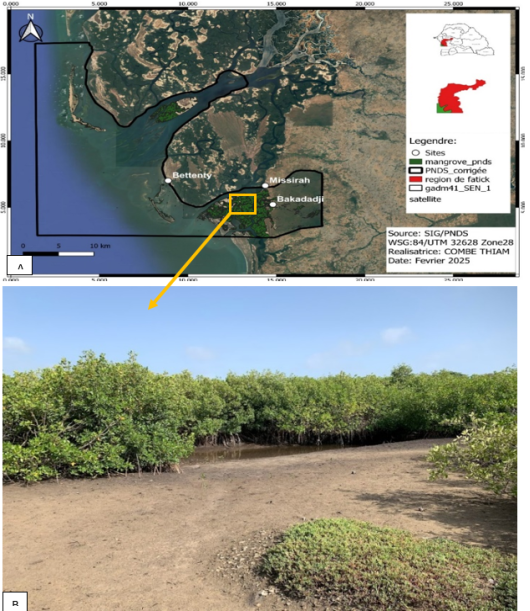
Figure 1. A. Map of the PNDS showing the collection sites (Bakadadji, Missirah, and Bettenty) B. Collection site in Bakadadji (Thiam, 2023).
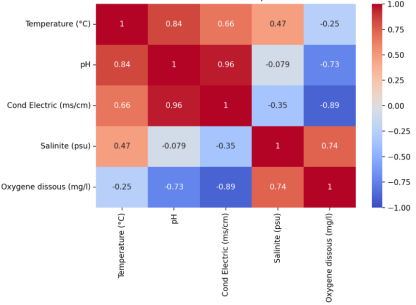
Figure 2. Correlation matrix of the physicochemical parameters of interstitial water in burrows.
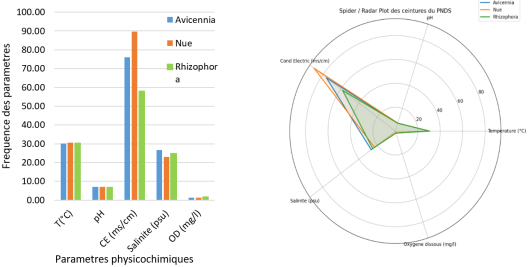
Figure 3. Histogram (a), spider web plot (b) of the parameters of the interstitial water in burrows by belt.
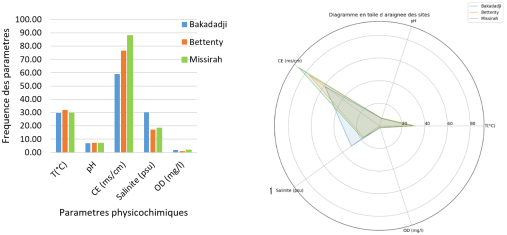
Figure 4. Histogram (c), spider web plot (d) of interstitial water parameters from Afruca tangeri burrows by site.
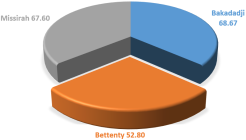
Figure 5. Individual Density by Site.
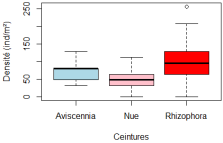
Figure 6. Density of Afruca tangeri individuals by belt zone.
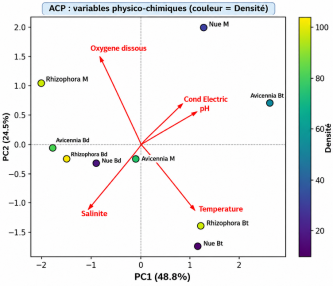
Figure 7. Density-dependent PCA of the physicochemical parameters (temperature, pH, electrical conductivity, salinity, dissolved oxygen) of the belts.

Information



 Share This Article
 Twitter
 Linked In
 Facebook

 Copy
 Download