
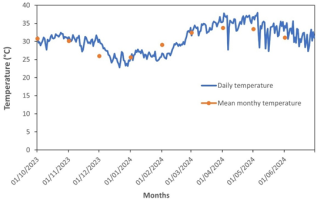
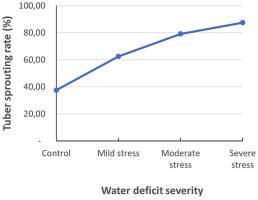
Tacca leontopetaloides, is a semi-wild food plant slightly domesticated and underutilized in tropical semi-arid regions due to the lack of information on its planting techniques, notably tuber sprouting attributes. This study aimed to assess the effect of water deficit severity on tuber sprouting attributes of T. leontopetaloides for improving its domestication strategies in the context of increasing drought events. Experiment trials were conducted in controlled conditions using a randomized complete block design, including four treatments based on water stress conditions: 100% field capacity (control), 75% (mild stress), 50% (moderate stress), and 25% (severe stress). Results showed that tuber sprouting rate significantly increased with water stress severity (X2 = 15.75; df = 3; p-value = 0.001276), with the lowest (37.5%) and highest (87.50%) rates recorded under control and severe stress conditions, respectively. In contrast, water deficit has no significant effect on tuber sprouting time, which ranged from 218 to 225 days after sowing, indicating a long dormancy. Tuber dormancy breaking started in April when ambient temperature increased. Our findings revealed that tuber sprouting of the species requires less water, indicating that its planting should occur in pre-rain season. This study provided significant insights to shape research on ecological drivers of T. leontopetaloides tuber dormancy.
| Published in | American Journal of Life Sciences (Volume 14, Issue 6) |
| DOI | 10.11648/j.ajls.20261406.13 |
| Page(s) | 167-172 |
| Creative Commons |
This is an Open Access article, distributed under the terms of the Creative Commons Attribution 4.0 International License (http://creativecommons.org/licenses/by/4.0/), which permits unrestricted use, distribution and reproduction in any medium or format, provided the original work is properly cited. |
| Copyright |
Copyright © The Author(s), 2026. Published by Science Publishing Group |
Domestication, Drought, Sprouting Rate, Tuber Dormancy
Estimate | SE | z value | Pr (>|z|) | |
|---|---|---|---|---|
(Intercept) | -2.38592 | 0.80312 | -2.971 | 0.002970** |
WDG | 0.94523 | 0.24745 | 3.820 | 0.000133*** |
TW | 0.04006 | 0.01948 | 2.056 | 0.039770* |
Estimate | SE | z value | Pr (>|z|) | |
|---|---|---|---|---|
(Intercept) | 5.1741184 | 0.0307861 | 168.066 | <2e-16*** |
WDG | -0.0057608 | 0.0091396 | -0.630 | 0.528ns |
TW | -0.0003218 | 0.0004739 | -0.679 | 0.497ns |
WDS | SD (days) | MST (days) |
|---|---|---|
Control | 13 (from 225 to 238 day) | 230 |
Mild stress | 32 (from 220 to 252 day) | 235 |
Moderate stress | 32 (from 220 to 252 day) | 235 |
Severe stress | 30 (from 218 to 248 day) | 229 |
AI | Aridity Index |
Fwc | Field Capacity |
SSW | Saturated Soil Weight |
DSW | Dry Soil Weight |
GLM | Generalized Linear Model |
| [1] | Thiombiano, A., Schmidt, M., Dressler, S., Ouedraogo, A., Hahn, K., Zizka, G. Catalogue des plantes vasculaires du Burkina Faso. Boissiera. 2012, 65, 1-391. |
| [2] | Ogbonna, A. I., Adepoju, S. O., Ogbonna, C. I. C., Yakubu, T., Itelima, J. U., Dajin, V. Y. Root tuber of Tacca leontopetaloides L. (Kunze) for food and nutritional security. Microbiology: Current Research, 2017, 1, 5-13. |
| [3] | Hahn, K., Schmidt, M., Thiombiano, A. The use of wild plants for food: a national scale analysis for Burkina Faso (West Africa). Flora et Vegetatio Sudano-Sambesica. 2018, 21, 25-33. |
| [4] | Bondé, L., Hien, B. S., Bougma, P. C., Da, S. S., Ouédraogo, O., Boussim, I. J. Promoting local knowledge on Tacca leontopetaloides (L.) Kuntze, a neglected and underutilized wild food plant for enhancing food security. Ethnobotany Research and Applications. 2026, 33, 1-11. |
| [5] | Binh, H. T., Dao, V. T. T. Study on the effects of harvesting time and storage conditions of Tacca leontopetaloides (L.) Kuntze Tuber in an Giang Province, Vietnam. IOP Conf. Series: Earth and Environmental Science, 2020. 515. |
| [6] | Bruschi, P., Mancini, M., Mattioli, E., Morganti, M., & Signorini, M. A. Traditional uses of plants in a rural community of Mozambique and possible links with Miombo degradation and harvesting sustainability. Journal of Ethnobiology and Ethnomedicine. 2014, 10, 1-22. |
| [7] | Amadi, C. O., Olojede, O. A., Ironkwe, A., Ebeniro, C. N., Nwokocha, C. C., Amadi, G., & Ejokwu, G. A. Prospects of domestication of polynesian arrowroot (Tacca leontopetaloides L.) in Nigeria. Nigerian Agricultural Journal. 2021, 52, 184-196. |
| [8] | Spennemann, D. H. R. Traditional arrowroot production and utilization in the Marshall Islands. Journal of Ethnobiology, 1994, 14, 211-234. |
| [9] | Borokini, T. I., Ayodele, A. E., Akinloye, A. J. Morphological and anatomical studies on Tacca leontopetaloides (L.) Kuntze (Taccaceae) in Nigeria. Research in Plant Biology. 2014, 4, 28-44. |
| [10] | Cepkova, P. H., Vitamvas, J., Viehmannova, I., Kisilova, J., Cusimamani, E. F., Milella, L. Simplified in vitro propagation protocol for Tacca leontopetaloides (L.) Kuntze and assessment of genetic uniformity of regenerated plantlets. Emirates Journal of Food and Agriculture. 2015, 27, 736-743. |
| [11] | Thiele, G., Friedmann, M., Polar, V., Campos, H. (2022). Overview, p. 3-28, In: THIELE, G.; FRIEDMANN, M.; CAMPOS, H.; POLAR, V.; BENTLEY, J. W. (Eds.) Root, Tuber and Banana Food System Innovations: Springer Nature Switzerland AG. |
| [12] | Aziz, S. A., Susanto, R. Are Tacca leontopetaloides (Linn.) O. Kuntze Mini Tuber Growth Affected by Media Composition and Tuber Size? Journal of Tropical Crop Science. 2015, 2, 1-9. |
| [13] | Hani, A, Damayanti, R. U., Megawati, T., Suharti, T., Zanzibar. The initial growth of tacca (Tacca leontopetaloides) as food crops in the agroforestry pattern with malapari. IOP Conf. Series: Earth and Environmental Science, 2021. 914. |
| [14] | Balbinot, L., Pessoa, A. D. C., Fachini, A. S. S., Gomes, L. S., De Souza, G. M. S., Kratz, D. Seed germination ecology of Callisthene kuhlmannii H. F. Martins: an endemic species from a biodiversity hotspot. Journal of Seed Science, 2025, 47, e202547034. |
| [15] | Xu, J., Li, W. L., Zhang, C., Liu, W., & Du, G. Z. Variation in seed germination of 134 common species on the eastern Tibetan Plateau: phylogenetic, life history and environmental correlates. Plos one. 2014, 9, e98601. |
| [16] | Bahadir, A., Sahinb, N. K., Beyazc, R., Yildiz, M. Magnetic field effect on breaking tuber dormancy, early sprouting, seedling growth, and tuber formation in potato (Solanum tuberosum L.). ScienceAsia. 2020. 46, 619-625. |
| [17] | Spinoni, J., Vogt, J., Naumann, G., Carrao, H., Barbosa, P. Towards identifying areas at climatological risk of desertification using the Köppen-Geiger classification and FAO aridity index. International journal of climatology. 2015, 35, 2210-2222. |
| [18] | Syarif, F., Lestari, P., Wawo, A. H. Growth characteristics variation of Tacca leontopetaloides (L.) Kuntze (Taccaceae) in Java and surrounding islands. Berita Biologi, 2014, 13(2), 161-171. |
| [19] | Traoré, I. C. E., Hien, B. S, Yaro, V. S. O., Zaré, A., Kaboré, M. L., Kabré, B., Bondé, L., Ouédraogo, O. Influence of seed size and pretreatments on Faidherbia albida (apple-ring) seed germination in Burkina Faso. Genetic Resources and Crop Evolution. 2026, 73, 1-13. |
| [20] | Moh, A., Massart, S., Jijakli, M., Lepoivre, P. Models to predict the combined effects of temperature and relative humidity on Pectobacterium atrosepticum and Pectobacterium carotovorum subsp. Carotovorum population density and soft rot disease development at the surface of wounded potato tubers. Journal of Plant Pathology. 2012, 94, 181-191. |
| [21] | Hrytseva, N. G., Skivka, L. M. Latent infestation of potato tubers with soft rot and ring rot pathogens under changing weather conditions in Ukraine. Microbiological journal. 2023, 6, 26-40. |
| [22] | De Souza‑Dias, J. A. C., Feldmann, F. Unintended sprouts as additional resource for pathogen‑free seed potato (Solanum tuberosum) propagation. Journal of Plant Diseases and Protection. 2024. 131, 1769-1778. |
| [23] | Park, H., Lee, G., Park, Y., Jin, Y., Choi, J., Seo, J., Cheon, C., Chang, D., Cho, J., Kang, J. Effects of seed tuber size on dormancy and growth characteristics in potato double cropping. Horticulture, Environment, and Biotechnology, 2023, 64, 167 - 178. |
| [24] | Arif, M., Ali, K., Muhammad, A., Ali, H., Hussain, I., Safdar, H., Noor, A., Kabir, R., Ali, S., Ali G. Impact of different nucleus tuber sizes on growth, yield, and physiology attributes of potato production. Notulae Botanicae Horti Agrobotanici Cluj-Napoca. 2024, 52, 14122. |
| [25] | Datir, S., Kumbhar, R., Kumatkara, P. Understanding physiological and biochemical mechanisms associated with post-harvest storage of Yam tuber (Dioscorea sp.). Technology in Horticulture. 2024, 4, e004. |
| [26] | Dogramaci, M., Dobry, E. P., Fortini, E. A., Sarkar, D., Eshel, D., Campbell, M. A. Physiological and molecular mechanisms associated with potato tuber dormancy. Journal of Experimental Botany. 2024, 75, 6093-6109. |
| [27] | Kwambai, T., Griffin, D., Nyongesa, M., Byrne, S., Gorman, M., Struik, P. Dormancy and Physiological Age of Seed Tubers from a Diverse Set of Potato Cultivars Grown at Different Altitudes and in Different Seasons in Kenya. Potato Research. 2023, 66, 1091-1115. |
| [28] | Rao, M. M., George, C. Studies to extend the dormancy of white yam (Dioscorea alata L). The journal of agriculture of the university of puerto rico. 1990, 74, 213-219. |
| [29] | Hamadina, E. I., Asiedu, R. Effect of Provenance and Storage Agroecology on Duration of Yam (Dioscorea rotundata Poir.) Tuber Dormancy. Agriculture, Forestry and Fisheries. 2015, 4, 95-100. |
| [30] | John, K. J., Antony, V. T., Marydas, J., Karuppaiyan, R. Tuber morphology, germination behaviour and propagation efficiency in three edible Momordica (Cucurbitaceae) species of India. Genetic Resources and Crop Evolution. 2009, 56, 861-868. |
| [31] | Muthoni, J., Kabira, J., Shimelis, H., Melis, R. Regulation of potato tuber dormancy: a review. Australian Journal of Crop Science. 2014, 8, 754-759. |
| [32] | Deligios, P., Rapposelli, E., Mameli, M., Baghino, L., Mallica, G., & Ledda, L. Effects of Physical, Mechanical and Hormonal Treatments of Seed-Tubers on Bud Dormancy and Plant Productivity. Agronomy, 2020, 10, 33. |
APA Style
Bondé, L., Ouédraogo, A. F. 1. J., Bougma, P. C., Tinto, A. D., Kagambéga, F. W., et al. (2026). Water Deficit Severity Increases Tuber Sprouting Attributes of Tacca Leontopetaloides (L.) in Tropical Semi-Arid Conditions. American Journal of Life Sciences, 14(6), 167-172. https://doi.org/10.11648/j.ajls.20261406.13
ACS Style
Bondé, L.; Ouédraogo, A. F. 1. J.; Bougma, P. C.; Tinto, A. D.; Kagambéga, F. W., et al. Water Deficit Severity Increases Tuber Sprouting Attributes of Tacca Leontopetaloides (L.) in Tropical Semi-Arid Conditions. Am. J. Life Sci. 2026, 14(6), 167-172. doi: 10.11648/j.ajls.20261406.13
@article{10.11648/j.ajls.20261406.13,
  author = {Loyapin Bondé and Abdoul Faouzi 1er Jumeau Ouédraogo and Pawend-taoré Christian Bougma and Abdou Dramane Tinto and Francois Wenemi Kagambéga and Oumarou Ouédraogo and Joseph Issaka Boussim},
  title = {Water Deficit Severity Increases Tuber Sprouting Attributes of Tacca Leontopetaloides (L.) in Tropical Semi-Arid Conditions},
  journal = {American Journal of Life Sciences},
  volume = {14},
  number = {6},
  pages = {167-172},
  doi = {10.11648/j.ajls.20261406.13},
  url = {https://doi.org/10.11648/j.ajls.20261406.13},
  eprint = {https://article.sciencepublishinggroup.com/pdf/10.11648.j.ajls.20261406.13},
  abstract = {Tacca leontopetaloides, is a semi-wild food plant slightly domesticated and underutilized in tropical semi-arid regions due to the lack of information on its planting techniques, notably tuber sprouting attributes. This study aimed to assess the effect of water deficit severity on tuber sprouting attributes of T. leontopetaloides for improving its domestication strategies in the context of increasing drought events. Experiment trials were conducted in controlled conditions using a randomized complete block design, including four treatments based on water stress conditions: 100% field capacity (control), 75% (mild stress), 50% (moderate stress), and 25% (severe stress). Results showed that tuber sprouting rate significantly increased with water stress severity (X2 = 15.75; df = 3; p-value = 0.001276), with the lowest (37.5%) and highest (87.50%) rates recorded under control and severe stress conditions, respectively. In contrast, water deficit has no significant effect on tuber sprouting time, which ranged from 218 to 225 days after sowing, indicating a long dormancy. Tuber dormancy breaking started in April when ambient temperature increased. Our findings revealed that tuber sprouting of the species requires less water, indicating that its planting should occur in pre-rain season. This study provided significant insights to shape research on ecological drivers of T. leontopetaloides tuber dormancy.},
 year = {2026}
}
TY  - JOUR
T1  - Water Deficit Severity Increases Tuber Sprouting Attributes of Tacca Leontopetaloides (L.) in Tropical Semi-Arid Conditions
AU  - Loyapin Bondé
AU  - Abdoul Faouzi 1er Jumeau Ouédraogo
AU  - Pawend-taoré Christian Bougma
AU  - Abdou Dramane Tinto
AU  - Francois Wenemi Kagambéga
AU  - Oumarou Ouédraogo
AU  - Joseph Issaka Boussim
Y1  - 2026/11/20
PY  - 2026
N1  - https://doi.org/10.11648/j.ajls.20261406.13
DO  - 10.11648/j.ajls.20261406.13
T2  - American Journal of Life Sciences
JF  - American Journal of Life Sciences
JO  - American Journal of Life Sciences
SP  - 167
EP  - 172
PB  - Science Publishing Group
SN  - 2328-5737
UR  - https://doi.org/10.11648/j.ajls.20261406.13
AB  - Tacca leontopetaloides, is a semi-wild food plant slightly domesticated and underutilized in tropical semi-arid regions due to the lack of information on its planting techniques, notably tuber sprouting attributes. This study aimed to assess the effect of water deficit severity on tuber sprouting attributes of T. leontopetaloides for improving its domestication strategies in the context of increasing drought events. Experiment trials were conducted in controlled conditions using a randomized complete block design, including four treatments based on water stress conditions: 100% field capacity (control), 75% (mild stress), 50% (moderate stress), and 25% (severe stress). Results showed that tuber sprouting rate significantly increased with water stress severity (X2 = 15.75; df = 3; p-value = 0.001276), with the lowest (37.5%) and highest (87.50%) rates recorded under control and severe stress conditions, respectively. In contrast, water deficit has no significant effect on tuber sprouting time, which ranged from 218 to 225 days after sowing, indicating a long dormancy. Tuber dormancy breaking started in April when ambient temperature increased. Our findings revealed that tuber sprouting of the species requires less water, indicating that its planting should occur in pre-rain season. This study provided significant insights to shape research on ecological drivers of T. leontopetaloides tuber dormancy.
VL  - 14
IS  - 6
ER  -
Department of Plant Biology and Physiology, Université Joseph KI-ZERBO, Ouagadougou, Burkina Faso
Department of Forestry Engineering, Université Yembila Abdoulaye TOGUYENI, Fada N’Gourma, Burkina Faso
Institute of Environmental and Agricultural Research (INERA), Centre National de la Recherche Scientifique et Technologique (CNRST), Ouagadougou, Burkina Faso
Department of Plant Biology and Physiology, Université Joseph KI-ZERBO, Ouagadougou, Burkina Faso

Information



 Share This Article
 Twitter
 Linked In
 Facebook

 Copy
 Download